



What Is the Oldest Mazda Car?
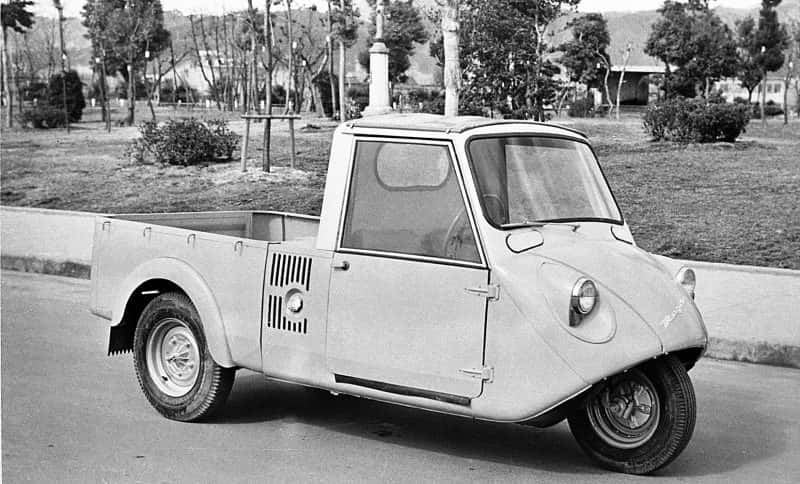
Before it built rotary engines and sports coupes, Mazda made cork. That leap from cork to cars is one of the stranger origin stories in the auto industry, and it set the tone for nearly a century of engineering ambition. The answer to “what’s the oldest Mazda” actually splits in two: the company’s first vehicle ever was the 1931 Mazda-Go three-wheeled truck, while its first true passenger car was the 1960 R360 Coupe. Both moments matter. Together they explain how this company worked its way into the industry, and why that founding spirit still shows up in the Mazdas parked on the lot at Sport Mazda South today.
What Is the Oldest Mazda Car, Really?
It depends on what you count as a “car.” Mazda’s very first vehicle wasn’t a traditional automobile at all, and the first genuine passenger car took nearly three decades to arrive.
The Mazda-Go: Mazda’s First-Ever Vehicle (1931)
The oldest Mazda vehicle ever built is the Mazda-Go Type-DA, a three-wheeled motorized truck that rolled out in 1931. It wasn’t a passenger car by any stretch, more a workhorse built to help small businesses haul goods through narrow city streets. The three-wheel layout kept costs down and made the truck easy to maneuver on Japan’s tight urban roads.
The Mazda-Go’s significance had nothing to do with looks. It was a gamble, plain and simple. The company had built its name on machine tools, and jumping into vehicle production demanded a real shift in engineering know-how and business thinking. That gamble paid off, and postwar three-wheelers like the K360 and T2000 carried the commercial lineage forward for years.
The R360 Coupe: Mazda’s First Passenger Car (1960)
Nearly thirty years after the Mazda-Go, Mazda released its first genuine passenger vehicle: the R360 Coupe, launched in Japan in May 1960. It was a kei car, Japan’s category for small, lightweight vehicles built for city driving. A rear-mounted 356cc air-cooled V-twin made roughly 16 hp, good for about 32 km/l with two people aboard, and buyers could choose a 4-speed manual or an early 2-speed “torque converter” automatic, quite advanced for a kei car at the time. The R360 seated four, weighed next to nothing, and moved a record 4,090 units in December 1960 alone.
The R360 Coupe changed the conversation around Mazda entirely. It showed the market the company had moved beyond commercial trucks into serious passenger car territory, cars that felt practical without giving up personality, a balance Mazda would chase for decades.
From Cork Company to Carmaker: Mazda’s Early Origins
Mazda traces back to Toyo Cork Kogyo Co., Ltd., founded in Hiroshima on January 30, 1920, by Jujiro Matsuda. As the name gives away, the business started out making cork products, an odd launching pad for a car company. The company nearly went bankrupt in the late 1920s before Hiroshima Saving Bank and local business leaders stepped in to save it.
Toyo Kogyo’s Journey Into Automaking
The company renamed itself Toyo Kogyo Co., Ltd. in 1927 and pivoted into machine tools. That pivot sharpened the manufacturing skills that would eventually cross over into vehicles, and by 1931 it had turned into the Mazda-Go. The name “Mazda” nods to Ahura Mazda, the Zoroastrian god of light and wisdom, while also echoing the name of founder Jujiro Matsuda. The formal rebrand to Mazda Motor Corporation came later, but the mindset built during those early Hiroshima years still runs through the brand.
The Rotary Era: Mazda’s Boldest Engineering Chapter
The Mazda-Go and R360 showed early ambition. The rotary era is where Mazda found its character, betting on an unconventional engine technology that cemented the brand as one willing to zig when everyone else zagged.
The Cosmo Sport 110S and the Wankel Engine
Mazda unveiled the Cosmo Sport at the Tokyo Motor Show in October 1963, and full production launched May 30, 1967, running through 1972. It was the world’s first volume-production sports car powered by a twin-rotor Wankel engine (the NSU Ro80 arrived with its own rotary that same year). Hand-built at roughly one per day, only 1,176 total were made, split between 343 Series I and 833 Series II cars, and only a small number are believed to survive today.
A Wankel engine works nothing like a piston engine. Instead of pistons pumping up and down inside cylinders, a triangular rotor spins inside an oval housing, producing power through continuous rotary motion. That gives you an engine that’s lighter and more compact than a comparable piston setup, noticeably smoother too. Other manufacturers licensed the Wankel design, but Mazda was the one that actually stuck with it, refining the technology for decades after most automakers walked away over fuel efficiency concerns.
RX-7 and RX-8: Carrying the Rotary Torch
The rotary engine found its most beloved home in the RX-7, introduced in Japan in March 1978, and its successor, the RX-8, produced from 2003 to 2012. Both became favorites among drivers who care more about handling balance than spec-sheet numbers. Mazda ended rotary production in 2012 when the RX-8 retired as the last of its kind, though the engine’s spirit resurfaced later as a range extender in the MX-30 R-EV plug-in hybrid.
Mazda’s Design Evolution Through the Decades
Engineering has always been central to Mazda’s story, but design has pulled just as much weight.
1960s-1980s: Building an Identity
Through the 1960s and 1970s, Mazda focused on becoming a credible automaker at home and abroad. Models like the Familia and Capella helped the brand gain footing in export markets. By the late 1980s, Mazda was building genuinely sporty cars, and the original MX-5 Miata debuted at the 1989 Chicago Auto Show, built at Mazda’s Hiroshima plant, and quickly became one of the best-selling sports cars ever made.
1990s-2000s: Refining Performance and Style
The 1990s and early 2000s were about refinement. Mazda poured resources into performance-focused models and developed a design language built around curves and dynamic proportions. The RX-8 arrived during this stretch, widening Mazda’s sports car lineup while keeping the rotary tradition alive.
Ford Motor Company also became a major shareholder during this era, a partnership that ran from 1974 to 2015. Ford’s stake grew from 24.5% in 1979 to 33.4% in 1995. That relationship brought resources for shared platforms and global expansion without ever turning into a full merger, and it shaped models like certain generations of the Mazda3 and Mazda6.
Today: KODO Design and SKYACTIV Engineering
Mazda’s current design language, KODO: Soul of Motion, arrived around 2010 and leans on fluid, sculpted surfaces that make a car look like it’s moving even when it’s parked in a driveway. The CX-5, Mazda3, and CX-90 show how well KODO translates to real-world vehicles, and Mazda regularly picks up recognition in design rankings across the industry.
Alongside KODO sits SKYACTIV technology, Mazda’s term for its efficiency-focused engineering across engine design, transmission tuning, chassis construction, and body structure. The idea behind it is simple: efficiency and driving enjoyment don’t have to fight each other. If that driver-first ethos sounds appealing, Sport Mazda South’s current lineup, including the MX-5 Miata and CX models, lets you feel it firsthand.
How Mazda’s History Shapes Its Cars Today
Mazda’s history still drives how the company builds cars today, it isn’t just a list of old models sitting in a museum somewhere. That same willingness to take risks that pushed Toyo Kogyo into vehicle manufacturing still shows up when Mazda revives a rotary engine in hybrid form or chases driver-focused dynamics while competitors go a different direction.
The craftsmanship that defined those early Hiroshima production floors still shows in the paint quality, interior materials, and chassis tuning across today’s lineup. Mazda has consistently built cars around how they feel to drive rather than just how they look on a spec sheet, a mindset that traces straight back to the engineering conviction behind the Cosmo Sport 110S and the original MX-5 Miata. Every new Mazda, from the lightweight MX-5 to the KODO-designed CX lineup, carries a piece of that heritage forward.
Explore Mazda’s Legacy at Sport Mazda South
Knowing where Mazda started makes it easier to appreciate where it’s landed. From the three-wheeled Mazda-Go to today’s KODO-designed SUVs and sedans, the brand’s story is one of constant reinvention built on real engineering conviction.
See the Legacy in Person
Sport Mazda South carries the full current Mazda lineup near Orlando, including new and certified pre-owned models, financing and leasing options, and service for today’s Mazdas.
- Test-drive the MX-5 Miata or a KODO-designed CX model to feel the lightweight, driver-first ethos that started with the R360 Coupe.
- Browse current SKYACTIV-equipped inventory built on the same engineering philosophy that made the Cosmo Sport 110S special.
- If you’re after a vintage Cosmo Sport or classic rotary Mazda, that falls outside our new and pre-owned inventory, so lean on a classic car specialist for pre-purchase inspection and appraisal.
Visit Sport Mazda South
Stop by, browse online, or schedule a test drive to see how nearly a century of Mazda engineering shows up in the car you drive home today.
0 comment(s) so far on What Is the Oldest Mazda Car?