



Mazda MX 5 vs. Honda CR-V
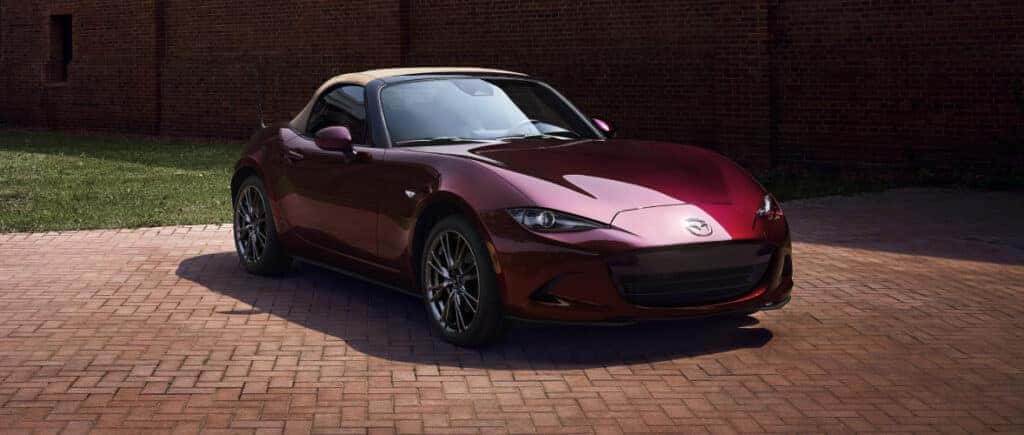
The 2025 Mazda MX-5 Miata and the 2025 Honda CR-V are two excellent cars by any measure of the imagination. But, which is best? The choice often boils down to one deciding factor: your lifestyle. The MX-5 Miata is a legendary sports car that’s perfect for an engaging wind-in-your-hair driving experience. On the other hand, the Honda CR-V is a practical and spacious compact SUV, offering comfort, cargo capacity and a load of family-friendly features.
The MX-5 is all about lightweight performance, with a curb weight of 2,366 pounds on the manual transmission model. The CR-V is significantly larger but perhaps more versatile, weighing 3,472 pounds in its base two-wheel-drive configuration (it’s even heavier with AWD). If you’re torn between a thrilling drive and everyday practicality, this comparison will help you determine which car is best for you.
Performance and Driving Experience
The Mazda MX-5 Miata has a 2.0-liter naturally aspirated four-cylinder engine that produces 181 horsepower and 151 lb-ft of torque. It pairs with rear-wheel drive and a direct, easy-to-shift manual transmission. An automatic transmission is optional and offers responsive handling and good steering. The rear-wheel-drive layout, near-perfect weight distribution and low center of gravity make the MX-5 one of the most agile and responsive sports cars on the market today.
The Honda CR-V has a 1.5-liter turbocharged four-cylinder that produces marginally more power at 190 horsepower and 179 lb-ft of torque, but the vehicle’s size largely drowns this out. It pairs with a continuously variable transmission and either front- or optional all-wheel drive. The MX-5 Miata is significantly lighter, allowing it to accelerate from 0-60 mph in 5.5 seconds, while the CR-V takes about 8.1 seconds. While it lacks the handling thrills we love in the Mazda, the new CR-V provides a stable, comfortable ride for daily commutes and family trips.
Interior and Comfort
The Mazda MX-5 Miata has a driver-focused cockpit and snug two-seater layout, while the Honda CR-V is a spacious five-seater with comfortable rear seating for kids. The Miata offers available leather finishes, removable cup holders, and an 8.8-inch touch-screen display with Bluetooth, Apple CarPlay, and Android Auto connectivity. A Bose stereo with speakers embedded in the headrests is an available option.
The CR-V is designed more for families than fun, and unless you splurge on the luxe EX-L, it’s more practically furnished. It has a 7-inch touch screen on the lower trims and a 9-inch screen on the EX-L. The larger screen has built-in navigation for peace of mind and wireless device charging for convenience. Apple CarPlay and Android Auto are standard across the lineup, but wireless connectivity is only included on the top trim.
Practicality and Daily Usability
The MX-5 is designed for pure driving enjoyment. Its compact size means limited space for passengers and cargo, but you can easily pack a weekend bag in the back with five cubic feet of space. It’s a fantastic car for zooming around the city, with EPA-estimated numbers of around 26 mpg in the city and 34 mpg on the highway.
The CR-V provides up to 76.5 cubic feet of cargo space with the rear seats folded, giving it considerably more space for people and cargo. It’s also fuel-efficient, offering 28 mpg in the city and 34 mpg on the highway, although these numbers drop slightly with all-wheel drive. If you need a daily driver with plenty of space, the CR-V wins hands down. Its higher ground clearance (7.8 inches vs. 4.9 inches for the MX-5) makes it more adaptable to rough roads and snowy conditions, while the MX-5 is best suited for weekend joyrides or as a second vehicle.
Safety and Reliability
Both vehicles boast excellent reliability ratings, but their safety features reflect their intended use. The Honda CR-V has Honda Sensing suite, including adaptive cruise control, lane-keeping assist, and collision mitigation. The Mazda MX-5 Miata offers all its driver-assistance features as standard. This includes automated emergency braking with forward-collision warning, adaptive cruise control, and blind-spot monitoring with rear cross-traffic alert.
Price and Value
The 2025 Mazda MX-5 Miata starts at around $29,530 for the base Sport trim and reaches $40,850 for the RF Club. There are five trims to choose from, each with its appeal — be it sport or luxury. 2025 Honda CR-V starts at $30,100 and extends to $35,000. It’s available in three trims (excluding hybrids), which add more frills and luxury as you go.
Warranties are an important factor when comparing value. Mazda offers a limited warranty for three years or 36,000 miles, while the powertrain is covered for five years or 60,000 miles. There is no complimentary scheduled maintenance provided. The Honda has the same limited and powertrain warranties but offers complimentary scheduled maintenance for the first year or 12,000 miles.
Mazda or Honda: Which is Better for You?
Deciding which vehicle is right for you depends on your preferences. The MX-5 is fun to drive and slightly more affordable, while the CR-V offers more value in terms of space, practicality and safety features. However, if you’re a driving enthusiast who values pure driving pleasure, agility and lightweight performance, the joy of piloting an MX-5 is priceless. The only way to know which is best for you is to compare both of them in real time. Visit our team at Sport Mazda South in Orlando, Florida, for a test-drive to experience the thrill of the MX-5 Miata for yourself.
0 comment(s) so far on Mazda MX 5 vs. Honda CR-V